Surface and soil
Name the finish, texture, joints, slope, contamination type, loading, temperature, and any pre-treatment. A before photograph fixes the starting condition.
Brush or pad action, solution delivery, pressure, flow, suction, filtration, squeegee geometry, travel speed, controls, and operator procedure interact. A technical review isolates those variables instead of assigning the result to a single feature.
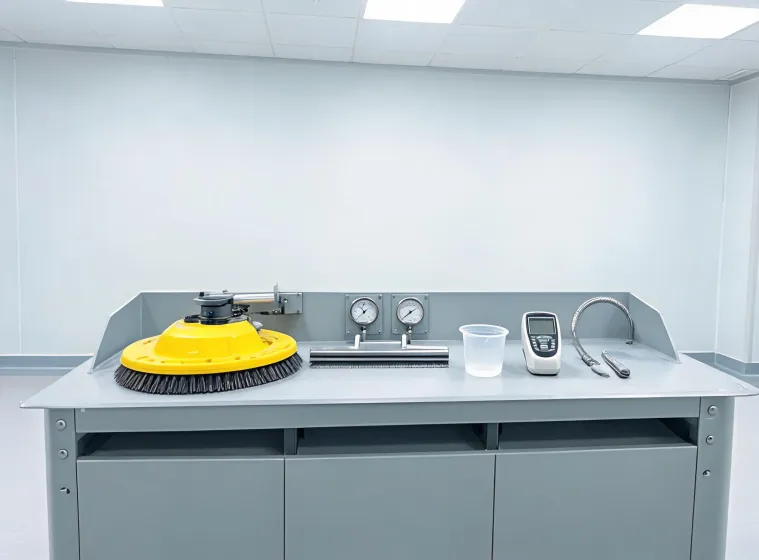
Dashboard values must come from the current model, the test setup, or direct observation. The examples below are measurement fields, not universal Kärcher performance claims.
Name the finish, texture, joints, slope, contamination type, loading, temperature, and any pre-treatment. A before photograph fixes the starting condition.
Record disc, roller, pad, brush, nozzle, hose, or floor tool; include material, wear condition, and installed orientation where relevant.
Record water temperature, chemistry name and concentration, solution flow, pressure, nozzle, and dwell. Do not compare settings that changed simultaneously.
Record travel speed, overlap, turns, passes, operator, and route length. Ten repeatable passes are more interpretable than an unrecorded demonstration.
Inspect liquid behind the squeegee, debris capture, visible film, edge performance, rebound, and filter loading at fixed observation points.
Separate productive passes from setup, transport, refill, dump, battery or cable handling, inspection, and end-of-shift cleaning.
Measure water, chemistry, energy or fuel, consumable wear, and collected material over the defined area. State the boundary and test duration.
Record traffic interaction, surface damage, aerosol or overspray, runoff, noise, visibility, operator reach, and any stop condition.
Product names and features can persist while specifications, accessories, approvals, or regional configurations change. Use the document revision and model identifier, not a generic family name, when making a final decision. Public pricing is also region-, channel-, configuration-, and service-scope dependent; this site does not invent a universal range.
Classify soil and collected material; review chemistry, traffic, runoff, energy isolation, hot surfaces, explosive atmospheres, and hazardous dust. General-purpose equipment must not be assumed suitable for a classified risk.
Confirm the exact model, regional configuration, intended use, restrictions, operator instructions, relevant conformity information, and compatible consumables or accessories.
Run the difficult route under documented conditions. Capture the environment, method, settings, observations, time blocks, consumption boundary, and any stop condition so another reviewer can follow the procedure.
Define pass or fail before the trial, record deviations, and document operator instruction. Re-test if a material variable changes; do not transfer an outcome from one floor or soil condition without verification.
Provide the current model reference if known, floor and soil description, route geometry, utilities, safety boundary, and the result you need to verify. The reply can focus on documentation gaps and a controlled test plan.